180 vs 360 Recruitment: Key Differences Explained for 2026
Finding the right talent in 2026 requires more than just posting a job ad. The recruitment landscape has split into two main paths. You likely want to know which setup gets you the best leads without wasting your budget. We will break down 180 vs 360 recruitment so you can make a fast, informed choice.
Most agencies claim they offer the best results. However, the internal structure of an agency changes how they find your candidates. A 360 recruiter acts as a single point of contact. They handle everything from finding the client to signing the candidate. A 180 recruiter focuses only on one side of that coin. Choosing the wrong one can lead to slow hires or poor communication.
We use our experience to show you which model fits your current needs. Whether you are an employer looking for a specialist or a job seeker wanting a personal touch, understanding these models is vital.
Core Difference Between 180 and 360 Recruitment
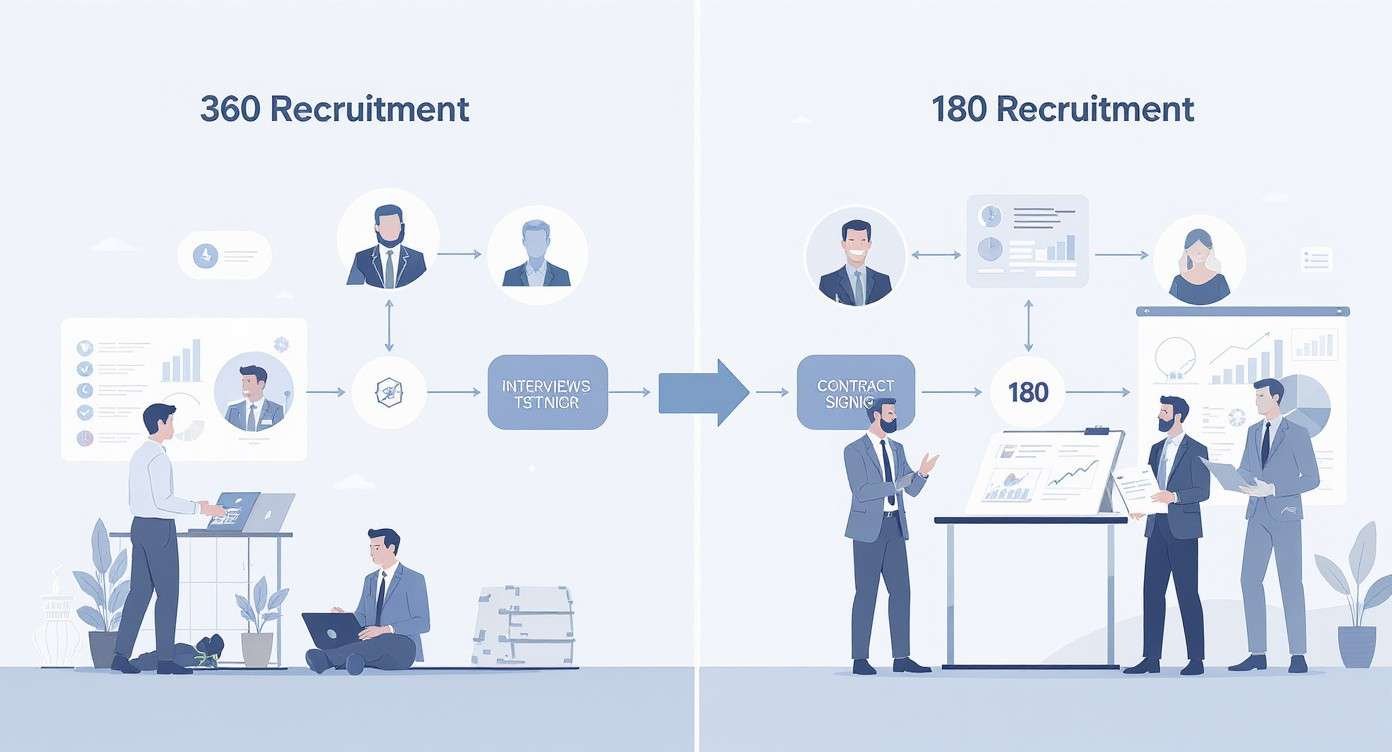
The main difference between 180 vs 360 recruitment lies in the scope of work. Think of the recruitment process as a circle. A 360 recruiter completes the full circle. They find the job, talk to the employer, source the talent, and manage the final offer. They are often called “full desk” recruiters.
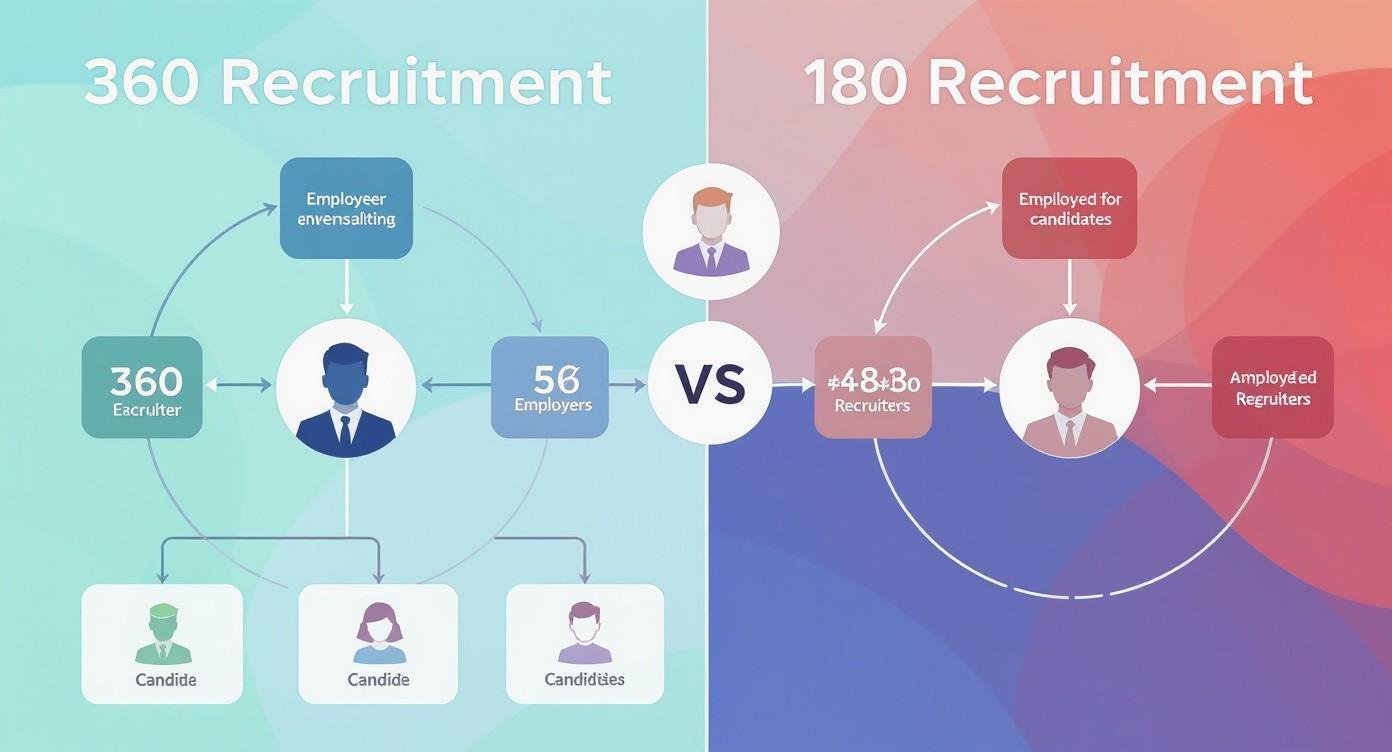
In contrast, 180 recruitment splits the circle in half. One person finds the jobs, and another person finds the people. This is often called a “split desk” model. The person finding the candidates is usually a delivery consultant or a resourcer. They do not spend time cold-calling companies because they focus entirely on the talent pool.
Why 360 Recruitment is the Standard for Many
We see the 360 model as the traditional approach. It offers high accountability. Since one person handles the entire deal, nothing gets lost in translation. They know exactly what the employer wants because they spoke to them. They also know what the candidate needs. This alignment often leads to higher-quality placements in niche markets.
Why 180 Recruitment is Growing
The 180 model is built for speed and volume. In 2026, many large agencies use this to scale. One specialist maps out the market to find every possible candidate. They are not distracted by sales meetings. This allows them to build deeper talent pipelines in specific industries like tech or healthcare.
360 vs 180 Recruitment: A Detailed Comparison
When we look at 360 vs 180 recruitment, we must evaluate how they perform in real-world scenarios. Each has distinct strengths.
Full Cycle Control
The 360 recruiter has total control. They manage the relationship with the hiring manager and the job seeker. This means the feedback loop is short. If a candidate is not a good fit, the recruiter knows why immediately. They can adjust their search without waiting for a briefing from a colleague.
Specialized Focus
The 180 recruiter provides a specialised focus. Because they do not have to find new business, they spend eight hours a day talking to talent. They often have better access to passive candidates who are not on job boards. If you need a high volume of candidates quickly, the 180 model usually wins on speed.
Communication Flow
The biggest risk in 180 recruitment is a communication breakdown. The person talking to the candidate might not fully grasp the “vibe” of the company culture because they haven’t met the boss. The 360 model removes this risk. However, 360 recruiters can become bottlenecks. If they are busy closing one deal, they might neglect sourcing for another.
Agency Recruitment Pros and Cons: 180 vs 360
Choosing between 180 and 360 recruitment depends on your goals. We have weighed the pros and cons to help you decide.
360 recruitment offers several advantages. Having a single point of contact allows clients to deal with only one person, which builds trust and saves time. Recruiters in this model often have deep market knowledge, understanding both the hiring side and the talent side, and there is consistency because the person who sold the service is also the one doing the work.
However, there are drawbacks. Recruiters can be overworked, which creates high pressure and increases the likelihood of mistakes. Sourcing may be slower because they cannot dedicate all their time to searching for candidates, and finding someone who excels in both sales and technical sourcing is rare.
On the other hand, 180 recruitment has its own set of advantages. It allows for speed to market as candidates are found much faster than with a 360 recruiter. Recruiters in this model often have greater talent expertise and are better at headhunting in difficult niches, and agencies can scale more easily by hiring additional resourcers to fill roles quickly.
The downsides include information gaps, as the recruiter may miss subtle requirements from the employer, and the process can feel more transactional and less personal for candidates. Additionally, if the two halves of the agency do not agree, internal conflict can stall the recruitment process.
Full Desk Recruiting vs 360 Recruitment
In the industry, we often hear the term full desk recruiting vs 360 recruitment. To be clear, these are the same thing. Both terms describe a recruiter who manages the business development and the candidate delivery.
However, “full desk” is a term more common in North America. “360” is the standard term in the UK and Europe. In 2026, the global market uses these interchangeably. If you are an employer, look for “full desk” if you want a partner who handles the entire strategy. If you prefer a “production line” approach for high-volume hiring, a split 180 desk is your best bet.
180 vs 360 Recruitment: How to Choose for 2026
We recommend assessing your internal resources first. If you have a strong HR team that can handle the final interviews and onboarding, a 180 agency is a cost-effective way to fill your pipeline. They act as an extension of your sourcing team.
If you are a small business owner with no time to manage interviews, you need a 360 recruiter. You want someone to take the “problem” off your plate and return with a signed contract. You pay more for this, but the time saved is worth the investment.
Use 360 recruitment if you are hiring for an executive or C-suite role, if the company culture is very specific and hard to match, or if you want a long-term partner who understands your business growth. Use 180 recruitment if you need to hire multiple people for the same role, if the skill set is very technical and requires deep sourcing, or if you already have an internal process to manage the final stages.
180 vs 360 Recruitment: Impact on Job Seekers
If you are a job seeker, the model affects your experience too. A 360 recruiter will likely stay with you from the first call to your first day at work. They can give you “insider” tips on the manager’s preferences.

A 180 recruiter might pass you off to an account manager once you agree to an interview. Do not be offended by this. It is just how their system works. The 180 recruiter is the expert at finding you; the account manager is the expert at getting you the best salary.
Summary
Choosing between 180 vs 360 recruitment is a strategic decision.
- 360 Recruitment offers a “white-glove” service with one point of contact. It is best for quality and complex roles.
- 180 Recruitment offers a “high-speed” service with specialised sourcers. It is best for volume and technical talent.
We believe that transparency about these models helps you get better leads. Do not just hire an agency. Ask them how they are structured. If they can’t explain their model, they probably don’t have a good one.
FAQs
Which model is more expensive for employers?
Usually, 360 recruitment carries a higher fee because the recruiter provides a more comprehensive service. However, 180 recruitment can become expensive if miscommunication leads to bad hires.
Is 360 recruitment better for tech hiring?
Not necessarily. Tech roles often require deep sourcing that 180 recruiters excel at. However, for a CTO role, a 360 recruiter is better suited to handle the complex negotiations.
Can an agency use both models?
Yes. Many modern agencies use a hybrid model. They have senior 360 consultants who lead the accounts and junior 180 resourcers who find the talent.
Why is it called 180 and 360?
It refers to the degrees in a circle. 360 degrees is a full circle (full process). 180 degrees is a half-circle (half the process).
Does the model affect the guarantee period?
No. Most agencies offer the same 3-month or 6-month replacement guarantee regardless of whether they use a 180 or 360 structure.