
Recruitment Marketing Guide: Strategies to Hire Top Talent
We see the same mistake every day. Companies post a job, pray for applicants, and wonder why they only get low-quality resumes. That is not a strategy. That is a gamble. In 2026, finding the right people requires a marketing mindset. We call this recruitment marketing. It is the process of using marketing tactics to attract, engage, and nurture talent before they even apply for a job.
If your hiring pipeline is dry, your brand is likely invisible. We are going to show you how to fix that. This guide covers everything from your recruitment marketing funnel to real-world recruitment marketing examples. We will keep it simple and actionable. No fluff. Just results.
Why Recruitment Marketing is Your New Competitive Advantage?
The old way of hiring is dead. Top-tier candidates do not look for jobs. Jobs find them. If you wait for someone to visit your “Careers” page, you have already lost. We use digital recruitment marketing to stay in front of people where they live: on social feeds, in niche communities, and through targeted search ads.
Think of a candidate like a customer. You would not expect a customer to buy a $100,000 product after seeing one ad. Why expect a candidate to commit their career to you after seeing one job post? You need touchpoints. You need a story. Most importantly, you need a system that works while you sleep.
Building a Data-Driven Recruitment Marketing Funnel
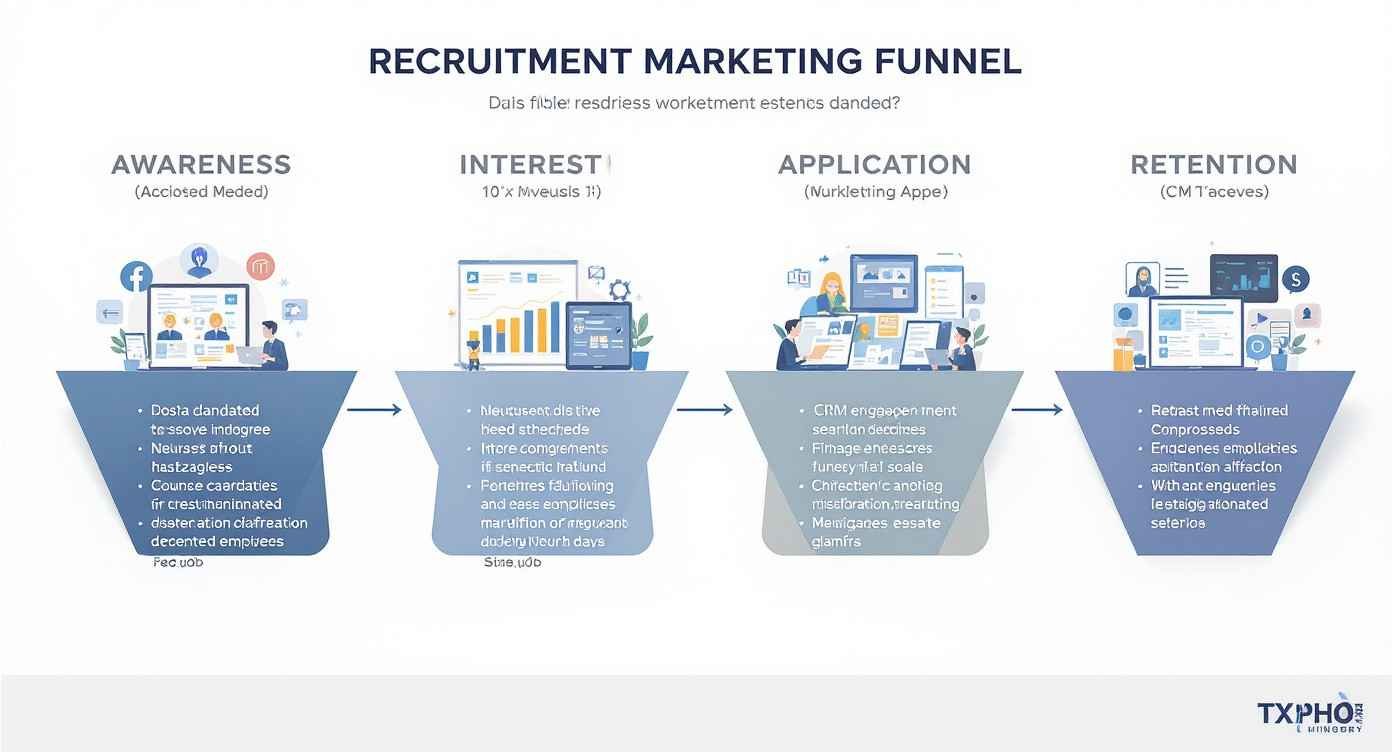
To win, you must understand the recruitment marketing funnel. It is not a straight line. It is a journey. We break it down into four distinct stages that move a stranger toward becoming a loyal employee.
Awareness: Getting on the Radar
This is the top of your funnel. At this stage, people do not know your company exists. We use recruitment marketing strategies like programmatic advertising and social media storytelling to create visibility. We focus on showing what it is actually like to work at our company. We don’t just say we have a “good culture.” We show the Friday wins, the hard problems we solve, and the people behind the desk.
Interest and Consideration
Once they know you, they start comparing you. They look at Glassdoor. They check your LinkedIn. This is where employer branding for recruitment becomes your biggest tool. If your social presence looks like a ghost town, candidates will run. We make sure our brand voice is consistent across every platform.
Application: The Conversion
This is the “Buy Now” button of hiring. If your application takes twenty minutes to fill out, you are killing your conversion rate. We treat the application form like a landing page. We keep it short. We make it mobile-friendly. Every extra click is a chance for a great candidate to quit.
Retention and Advocacy
Recruitment marketing does not end with a signed contract. Your current employees are your best recruiters. We encourage our team to share their stories. Employee-generated content has higher trust levels than any corporate video. We use these stories to feed the top of the funnel again.
Effective Recruitment Marketing Strategies for 2026
We don’t do “best practices” because everyone else is doing them. We do what works. Here are the strategies we use to dominate the talent market.
Search Engine Optimisation for Job Posts
If your job descriptions aren’t ranking, they don’t exist. We treat job posts like sales pages. We use keywords that candidates actually search for. Instead of “Coding Ninja,” we use “Senior Full Stack Developer.” We optimise for Google for Jobs by using clean schema markup. This ensures our roles appear at the very top of search results.
Programmatic Job Advertising
Stop buying individual job board posts. It is a waste of money. We use programmatic tools to buy ad space only when and where our target persona is active. If we need a data scientist, our ads show up on tech blogs and GitHub, not just general job boards. This saves our budget and increases lead quality.
Social Media Nurturing
We use LinkedIn, Instagram, and even TikTok to build a talent community. We do not just post “We Are Hiring” graphics. We share insights. We teach. We provide value. When a candidate is finally ready to switch jobs, our company is the first one they think of because we have been in their feed for months.
Employer Branding for Recruitment: More Than a Logo
Your brand is not your colour palette. It is the promise you make to your employees. We see too many companies trying to be “everything to everyone.” That is a fast track to being nothing to anyone.
We define our Employee Value Proposition (EVP) clearly. What do we offer that no one else does? Maybe it is a four-day work week. Maybe it is a massive budget for learning. We pick one or two core pillars and scream them from the rooftops.
A strong brand also acts as a filter. We want the wrong people to see our brand and realise they would not fit in. This saves us time and keeps our funnel filled with high-intent leads.
Real-World Recruitment Marketing Examples
Let’s look at who is doing this right. These recruitment marketing examples show the power of a clear strategy.
- The “Day in the Life” Series: One tech firm started filming raw, unedited videos of their engineers. No scripts. No fancy lighting. Just real talk about the bugs they were fixing. Their application rate for senior roles tripled in six months.
- The Interactive Quiz: A creative agency built a “Culture Fit” quiz. It wasn’t a boring personality test. It was a fun, fast way for people to see if they liked the agency’s fast-paced style. It captured email addresses and built a massive talent pipeline.
- The Referral Engine: A healthcare provider turned their employees into brand ambassadors. They gave their team easy-to-share social media kits. When an employee shared a post, they got points toward a bonus. This lowered their cost-per-hire by 40%.
The Role of Technology in Digital Recruitment Marketing
You cannot run a modern campaign with an Excel sheet. We use Recruitment Marketing Platforms (RMP) to automate the heavy lifting. These tools act like a CRM for talent.
We track every source. If LinkedIn brings us 100 clicks but zero hires, we stop spending there. If a niche blog brings us two hires from five clicks, we double down. We use data to drive our decisions. We also use AI to personalise our outreach. We don’t send “Dear Candidate” emails. We send messages that reference their specific skills and interests. It sounds human because we put the work in to make it relevant.
How to Measure Your Success?
If you don’t measure it, you can’t improve it. We focus on a few key metrics that actually impact the bottom line.
- Source of Hire: Where do your best people come from?
- Conversion Rate: What percentage of people who view your job post actually apply?
- Cost Per Lead: How much are you spending to get one qualified applicant into your funnel?
- Brand Awareness: Are people searching for your company by name?
We look at these numbers weekly. If the data dips, we change the creative. We don’t wait for a quarterly review to fix a failing campaign.
Overcoming Common Hiring Obstacles
Most companies fail because they are too slow. We see great candidates get snatched up because a hiring manager took five days to reply to an email. We treat recruitment marketing like a race.
We also see companies with a “post and pray” mentality. They think a single job board will solve their problems. It won’t. You need a multi-channel approach. You need to be where your candidates are, whether that is on a podcast, a newsletter, or a professional forum.
Conclusion: Start Building Your Talent Pipeline Today
Recruitment marketing is not a luxury. It is a necessity. If you want to grow, you need a predictable way to find talent. Stop treating hiring like an administrative task. Start treating it like the high-stakes marketing operation it is.
We have shown you the funnel. We have given you the strategies. Now, it is time to execute. Audit your current brand. Fix your application process. Start telling your story. The companies that win the next decade will be the ones that master the art of attracting people, not just hiring them.
FAQs
What is the difference between recruiting and recruitment marketing?
Recruiting is the act of interviewing and hiring for a specific open role. Recruitment marketing is everything that happens before that. It is the work of building a brand and an audience so that when you have a role, you already have a pool of interested people.
How much should we spend on recruitment marketing?
There is no one-size-fits-all number. We suggest starting with a small budget for targeted social ads and SEO. Measure your cost-per-hire. If it is lower than your traditional headhunter fees, you should reallocate that money into your marketing funnel.
Does employer branding really matter for small businesses?
It matters more for small businesses. You can’t compete with the salaries of giant corporations. You have to compete on culture, mission, and the individual experience. A strong employer brand is your only way to stand out against the “big guys.”
How long does it take to see results?
SEO and branding are long-term plays. You might see a jump in applications within a month of fixing your job posts. However, building a true talent community usually takes six to twelve months of consistent effort.
Which social media platform is best for hiring?
It depends on who you want to hire. LinkedIn is the standard for professional roles. For creative or younger talent, Instagram and TikTok are often better. We go where our target persona spends their time. Don’t try to be everywhere at once. Pick one platform and do it well.
