
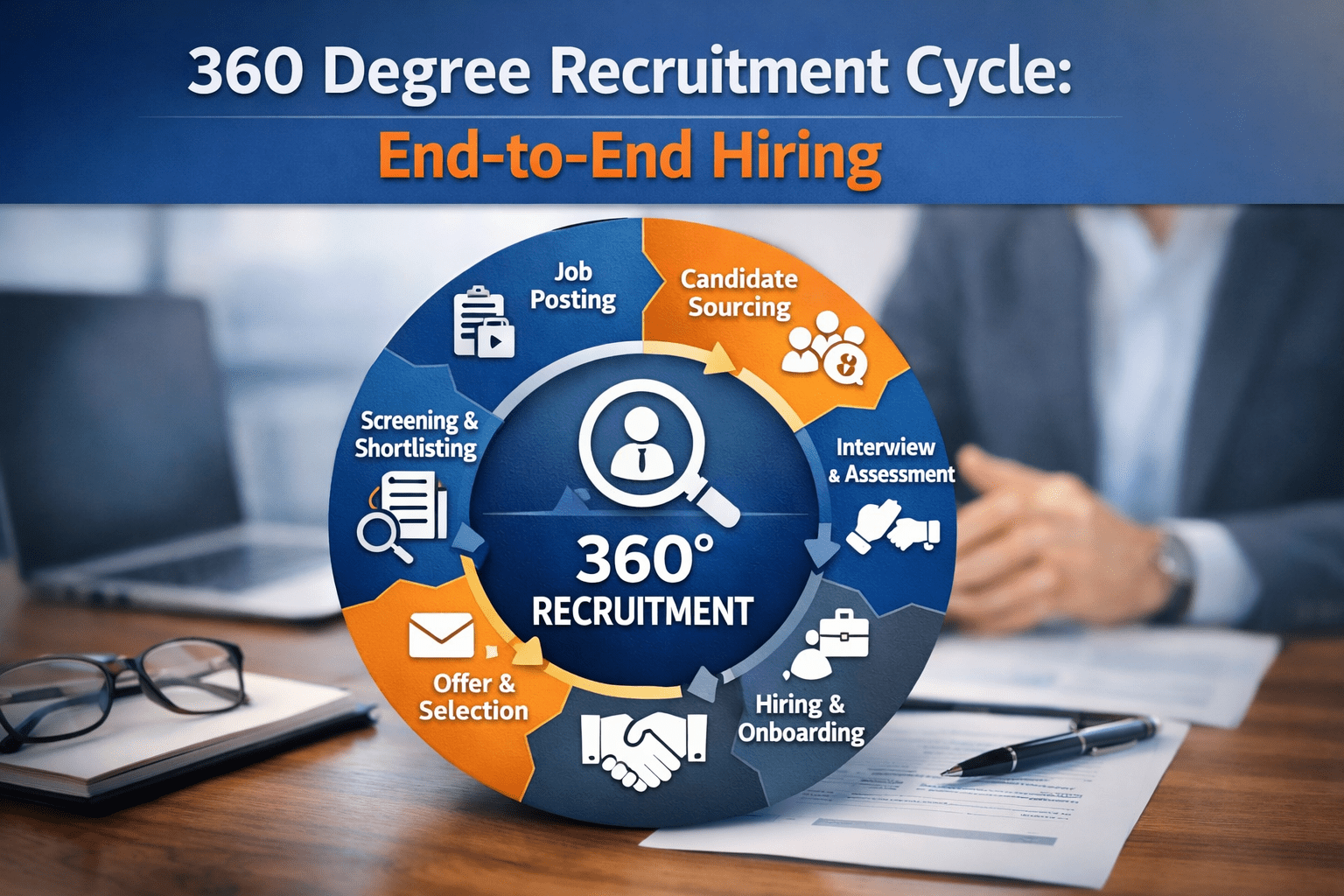
360 Degree Recruitment Cycle: End-to-End Hiring
360 Degree Recruitment Cycle: The Complete End-to-End Hiring Process Explained
Hiring the right people has never been more important or more complex than it is today. Companies are no longer just filling vacancies; they are building teams that drive growth, culture, and long-term success. This is where the 360 degree recruitment cycle plays a vital role.
The 360 degree recruitment cycle refers to a comprehensive, end-to-end hiring process that covers every stage of recruitment, from identifying workforce needs to onboarding and post-hire follow-up. Instead of treating recruitment as a single action, this approach views hiring as a continuous, interconnected process.
Organizations that adopt the 360 degree recruitment cycle benefit from better candidate quality, improved retention, and stronger employer branding. More importantly, it brings structure, clarity, and consistency to a process that can otherwise feel chaotic.
Understanding the Concept of the 360 Degree Recruitment Cycle
At its core, the 360 degree recruitment cycle is a holistic approach to talent acquisition. It ensures that every step of hiring is planned, executed, and reviewed carefully. Rather than focusing only on sourcing candidates, it emphasizes the entire candidate journey.
This cycle begins long before a job advertisement is published and continues even after a candidate joins the organization. Each stage feeds into the next, creating a loop that supports continuous improvement in hiring outcomes.
By using a 360 degree recruitment cycle, businesses shift from reactive hiring to strategic workforce planning. This results in stronger teams and more sustainable growth.
Why the 360 Degree Recruitment Cycle Matters Today
Modern hiring challenges are complex. Skill shortages, high competition for talent, and evolving employee expectations make traditional recruitment methods less effective. The 360 degree recruitment cycle addresses these challenges by offering a structured yet flexible framework.
One of the biggest advantages of this approach is alignment. 180 Recruiting Consulting, Hiring managers, HR teams, and recruiters work together with shared goals and clear responsibilities. This reduces miscommunication and ensures everyone is working toward the same outcome.
Additionally, candidates experience a more transparent and professional hiring process. Clear communication, timely feedback, and structured evaluations improve candidate satisfaction and strengthen employer reputation.
Key Stages of the 360 Degree Recruitment Cycle
While the exact structure may vary across organizations, the 360 degree recruitment cycle typically includes several interconnected stages that work together to deliver effective hiring results.
Workforce Planning and Job Analysis
The recruitment cycle begins with understanding the organization’s needs. Workforce planning involves analyzing current team capacity, future goals, and skill gaps. This stage ensures hiring decisions are driven by strategy rather than urgency.
Job analysis follows, where responsibilities, required skills, and expectations are clearly defined. A well-written job description sets the foundation for attracting the right candidates and reduces mismatches later in the process.
Talent Sourcing and Candidate Attraction
Once the role is defined, the next step in the 360 degree recruitment cycle is sourcing talent. This includes advertising jobs, leveraging professional networks, employee referrals, and talent databases.
Effective sourcing goes beyond posting vacancies. It involves understanding where the ideal candidates are and how to engage them with compelling messaging. Organizations that invest in employer branding often see stronger candidate interest and better response rates.
Screening and Shortlisting Candidates
Screening is a critical stage where resumes are evaluated against job requirements. However, in a true 360 degree recruitment cycle, screening goes beyond keyword matching.
Recruiters assess skills, experience, communication ability, and potential cultural fit. Structured screening processes help ensure fairness and consistency while reducing unconscious bias.
Interviewing and Candidate Evaluation
Interviews are where deeper insights are gained. In the Staffing vs. recruitment agency, interviews are structured and purpose-driven. Each interaction is designed to assess both technical competence and behavioral qualities.
Hiring teams may use multiple interview formats, such as competency-based interviews, situational questions, or practical assessments. The goal is to gather a complete picture of the candidate rather than relying on first impressions.
Selection and Job Offer Management
After interviews, candidates are evaluated based on predefined criteria. This stage requires collaboration between recruiters and hiring managers to make objective, well-informed decisions.
Once a candidate is selected, offer management becomes crucial. Clear communication around salary, benefits, expectations, and timelines ensures transparency and builds trust. A smooth offer process increases acceptance rates and sets a positive tone for the employment relationship.
Onboarding and Integration
The recruitment cycle does not end with an accepted offer. Onboarding is a key part of the 360 degree recruitment cycle and plays a major role in employee retention.
Effective onboarding helps new hires understand their roles, integrate into the team, and feel supported from day one. Structured onboarding programs reduce early turnover and improve employee engagement.
Post-Hire Review and Feedback
The final stage of the cycle focuses on reflection and improvement. Post-hire evaluations assess whether the recruitment process delivered the desired results.
Feedback from hiring managers and new employees provides valuable insights. These learnings are then used to refine future hiring strategies, completing the full recruitment loop.
Benefits of the 360 Degree Recruitment Cycle
-
Better alignment between business goals and hiring decisions
-
Improved candidate experience and employer branding
-
Reduced time-to-hire and hiring costs
-
Higher employee retention and engagement
-
Continuous improvement through feedback and analysis
360 Degree Recruitment Cycle vs Traditional Hiring
Traditional recruitment often focuses on filling roles quickly, sometimes at the expense of long-term fit. In contrast, the 360 degree recruitment cycle prioritizes quality, consistency, and sustainability.
Instead of treating hiring as a one-time event, this approach recognizes recruitment as an ongoing process that evolves with the organization. It allows businesses to adapt to changing workforce needs without compromising on standards.
Role of Technology in the 360 Degree Recruitment Cycle
Technology supports the recruitment cycle by improving efficiency and data accuracy. Applicant tracking systems, recruitment analytics, and communication tools help streamline each stage.
However, technology does not replace human judgment. In a successful 360 degree recruitment cycle, technology enhances decision-making while recruiters maintain personal connections with candidates.
Common Challenges and How to Overcome Them
Implementing a 360 degree recruitment cycle can be challenging without proper planning. Some organizations struggle with coordination, time constraints, or resistance to change.
Clear documentation, stakeholder alignment, and regular training help overcome these challenges. When teams understand the value of the full recruitment cycle, adoption becomes smoother and more effective.
Why the 360 Degree Recruitment Cycle Is a Long-Term Investment
Recruitment shapes the future of any organization. By adopting the 360 degree recruitment cycle, companies invest in long-term workforce stability rather than short-term hiring fixes.
This approach builds stronger teams, reduces costly turnover, and supports organizational growth. Over time, the benefits compound, making recruitment a strategic driver of success.
(FAQs)
1. What is the 360 degree recruitment cycle?
The 360 degree recruitment cycle is an end-to-end hiring process that covers workforce planning, sourcing, screening, interviewing, onboarding, and post-hire evaluation.
2. Who should use the 360 degree recruitment cycle?
It is suitable for businesses of all sizes that want structured, consistent, and high-quality hiring outcomes.
3. How does the 360 degree recruitment cycle improve retention?
By focusing on role fit, culture alignment, and effective onboarding, it helps reduce early employee turnover.
4. Is the 360 degree recruitment cycle time-consuming?
While it requires planning, it ultimately saves time by reducing rehiring, mismatches, and recruitment errors.
5. Can small businesses implement this recruitment cycle?
Yes, the cycle can be scaled to match the size and resources of small businesses while maintaining its core principles.
